 Hogtown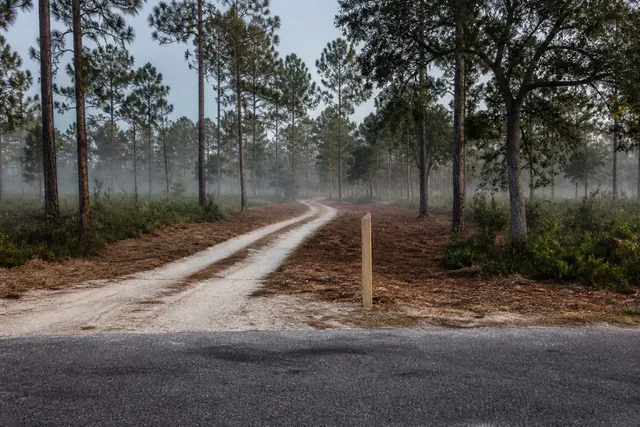
Hogtown Land Clearing puts Gainesville property owners in front of a local land clearing contractor for access road & driveway clearing across Gainesville and Alachua County.
A lot of Alachua County acreage is bought on a promise and a flagging tape: the good homesite is back there, once something drivable connects it to the county road. Access clearing builds that connection — a corridor cut through the pines and scrub oak, stumps out, surface shaped — whether it is a hundred-foot residential drive in Jonesville or a half-mile farm road out toward Hawthorne's timberland.
Corridor design is mostly a conversation about vehicles. A car needs twelve to fourteen feet of cleared width; add canopy clearance for delivery box trucks; make it sixteen-plus with wider turns if a fire apparatus, horse trailer, or log truck will ever use it. Cutting the corridor generously once costs far less than widening it after fences and plantings crowd the edges.
Under-tire matters more than width. The native sugar sand drives beautifully dry and turns to a sugar-bog after a wet week; the fix is geometry plus material — crown the surface, ditch or swale the low side, and cap wear areas with limerock where the budget allows. Culverts belong wherever the road crosses a wet-weather flow path, sized for the storm, not the average day.
Routing is where local eyes pay for themselves: skirting the sinkhole-prone depressions instead of filling them, holding the grade line where a loaded trailer can stop on wet sand, saving the corridor's best live oaks as shade rather than casualties, and keeping the approach angle at the county road legal and sane.
Describe the run — from where to where, and what has to drive it — and Hogtown Land Clearing will have a local contractor walk the route and quote clearing, stumps, culverts, and surface as separate written lines you can phase.
Building a sand road that outlives the summer
Rain is the design load here — the Gainesville area's storm pattern, documented by NWS Jacksonville, delivers inches in an afternoon, and a flat, uncrowned sand road becomes a canal in exactly one of those. The old fixes still work: three to four percent crown, shoulders mulched rather than bare, water turned off the surface every couple hundred feet with a gentle broad dip rather than allowed to gather speed. On internally drained karst ground, getting water off the road and into vegetated sand quickly is both the maintenance plan and the environmentally right answer — the aquifer beneath is the one the Suwannee River WMD spends its budget protecting.
Limerock capping is the local upgrade path: a compacted lift over the sand in the steep or shaded segments carries traffic all summer. Full-length capping is nice; strategic capping is smart.
Driveway connections and the paperwork at the pavement
Regulation concentrates at the pavement end of the run. Tying a new drive into a county road brings a connection permit and sightline standards — Alachua County handles those for unincorporated parcels — and state highways have their own process. It is unglamorous paperwork that prevents the genuinely bad outcome: a finished drive that meets the road at a blind crest.
Utilities ride the same corridor thinking. Power, well feed, and fiber conduit want to be trenched while the corridor is freshly cleared and unplanted — coordinate the trades once, and the road never gets cut open twice.