 Hogtown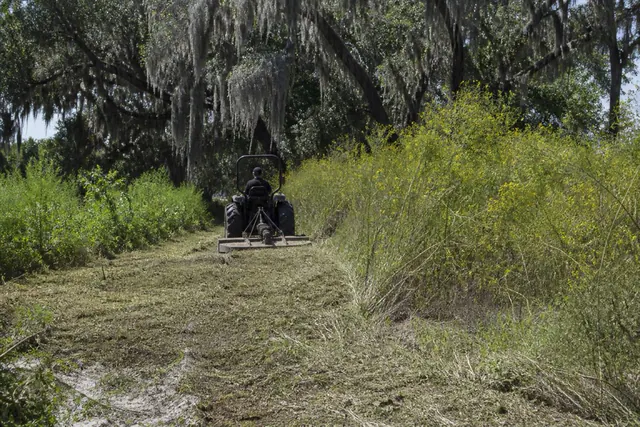
Hogtown Land Clearing puts Gainesville property owners in front of a local land clearing contractor for brush & underbrush clearing across Gainesville and Alachua County.
Leave a north-central Florida parcel alone for three summers and the understory writes its own plan: dog fennel head-high by August, blackberry running under it, muscadine and catbrier climbing anything vertical, and a nursery of laurel oak and cherry seedlings filling every gap. Underbrush work removes that middle layer and spares everything overhead: live oaks, longleaf, and hickories all stay rooted exactly where they grew.
The right tool changes with the growth. Soft annual cover falls to a bush hog behind a compact tractor; woody understory with finger-thick stems calls for a grinding head instead of a spinning blade; vine-bound hammock edges sometimes call for hand crews with saws working ahead of the machine so nothing valuable gets pulled down with the tangle.
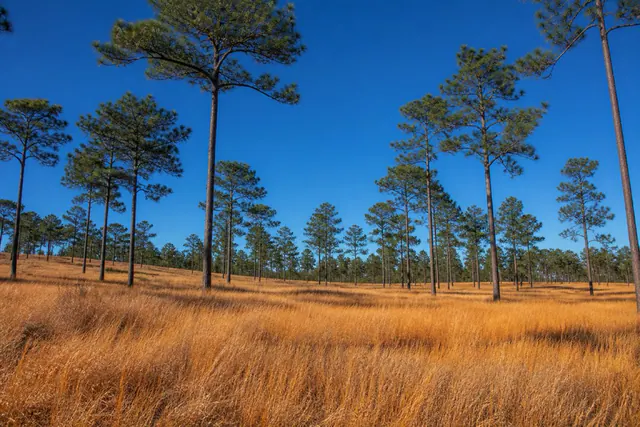
There is a real safety case for the work beyond looks. The sandhill and flatwoods plant communities around Gainesville are built to burn, and an unbroken fuel ladder from wiregrass up through yaupon into the pine crowns is the textbook setup for a bad day in a dry May. Opening the understory breaks that ladder — the same reason public land managers here run prescribed fire on a rotation.
Underbrush work is also where wildlife rules actually bite. Gopher tortoises dig their burrows in exactly the open sandy ground this county specializes in, and a burrow in the work area changes the plan legally, not optionally. A contractor who clears here full-time spots the half-moon burrow aprons on the walk-through and prices the job around them.
Describe the parcel to Hogtown Land Clearing — acreage, how thick, what you want kept — and a local operator will walk it with you and put the whole scope in a written, itemized quote at no cost.
Watch for burrows before the first pass
The gopher tortoise is a protected species in Florida, and state rules enforced through the FWC, Florida's wildlife agency, prohibit disturbing tortoises or their burrows without a permit. On the dry sands of western Alachua County, burrows are common enough that checking for them is a standard first step, not an exotic one. Marking a buffer around an active burrow and mowing around it usually costs nothing; hitting one with equipment can cost a great deal.
The flip side is that cleared, open ground is what these animals need — overgrown parcels shade out the low forage they graze. A thoughtful clearing job on sandhill acreage often leaves the property better tortoise habitat than the thicket was, which is a rare case of the paperwork and the outcome pointing the same direction.
Keeping it cleared without doing it twice
Dog fennel and blackberry are not defeated by one mowing — they are perennials working off root reserves. The UF/IFAS Extension office for Alachua County publishes practical guidance on pasture weeds and woody regrowth, and the short version is that timing matters: cutting in late summer, before the plants bank energy for winter, sets them back far harder than a spring pass.
For most owners the sustainable rhythm is one thorough machine clearing to reset the parcel, then an annual or twice-annual mow that takes an afternoon instead of a week. Species guides in the EDIS library can help you decide which volunteers are worth keeping — a young longleaf is a different find than a laurel oak seedling in a fence line.