 Hogtown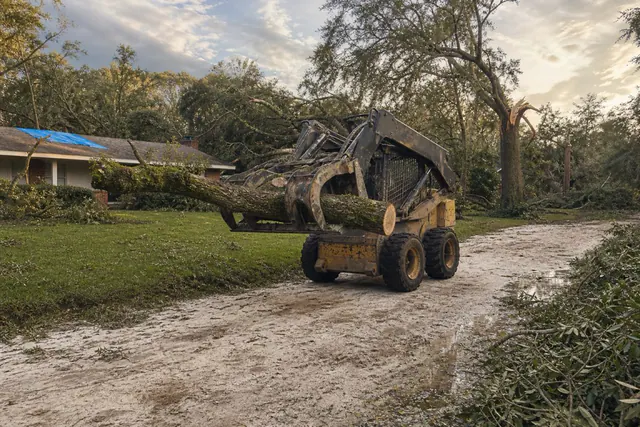
Hogtown Land Clearing puts Gainesville property owners in front of a local land clearing contractor for storm debris cleanup across Gainesville and Alachua County.
Gainesville's storm season announces itself most June afternoons: towering cumulus, a black line to the west, and thirty violent minutes that can drop a water oak across a fence or peel a pine crown into the yard. Beyond the daily thunderstorms sit the bigger visitors — tropical systems that cross north Florida and leave the whole county cutting its way out for a week.
Storm cleanup is its own discipline because storm wood is loaded wood. A leaning oak hung in a neighbor's canopy, a root ball primed to heave upright the moment the trunk is severed, a limb pinned under tension across a driveway — each stores energy that punishes casual chainsaw work. Crews that do this every summer read those loads first and cut in the order that releases them safely.
The equipment matters as much as the reading. A grapple on a skid steer or truck moves a trunk section in one bite that would take a crew an hour to buck and drag, and a mulcher head turns limb piles into ground cover instead of a month-long burn pile. On sandy Gainesville yards, tracked machines make quick work without leaving ruts to repair behind the repair.
The paper side deserves attention while the saws run. Homeowner policies routinely cover debris removal connected to covered damage, and insurers want photos before, during, and after. An itemized invoice that separates the tree off the roof from the general yard cleanup is exactly what an adjuster wants to see — and exactly how quotes through this site are written.
When the weather has done its worst, tell Hogtown Land Clearing what is down and what it is on. A local crew will prioritize the dangerous pieces, quote the whole cleanup in writing, and get the property walkable again.
After the storm: order of operations
The professional sequence is stable across storms: life-safety hazards first — anything touching lines waits for the utility, no exceptions — then access, cutting the driveway and doorways clear; then structures, working tarps and trunk removal on roofs; then the general debris field. Watching the forecast discipline from NWS Jacksonville matters even after landfall, because a second rain band on a tarped roof rearranges priorities fast.
After county-declared events, Alachua County and the municipalities publish debris-pickup rules — what gets stacked at the right-of-way, cut lengths, and schedules. A crew that knows the current rules stages your piles so they actually leave on the first pass.
Burn pile or chip pile?
The reflex after a storm is to burn the mountain, and it is usually the wrong call inside Gainesville's growth ring. Yard-debris burning in Florida sits under state rules with setbacks and conditions — the details live on the state's open burning page — and post-storm weeks are exactly when everyone else is burning too, air quality complaints spike, and dry snags still stand everywhere. Chipping the pile is faster than tending a fire for three days, and the chips have somewhere useful to go on almost any Alachua County lot.
Genuinely large trunk wood is a different stream: oak rounds disappear fast as firewood in this town, and pine logs can be set aside for the sawyer or hauled with the rest — a per-load line on the invoice either way.