 Hogtown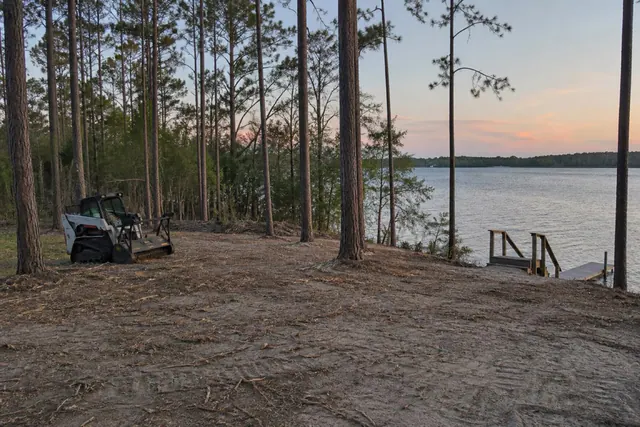
Hogtown Land Clearing puts Melrose property owners in front of a local land clearing contractor for mulching, clearing, and site prep around Melrose.
Melrose is the county line's lake town — an unincorporated community spread across the corners of four counties at the foot of Lake Santa Fe, with an Alachua County side that runs down SR-26 through pine and lake-cottage country. No census place measures it, which suits Melrose fine; it has always counted itself in lakefronts and porches rather than rows of rooftops.
Lake living sets the clearing agenda. Cottage lots want the understory opened so breeze and water view come back through the pines. Older family places carry decades of volunteer growth between house and shore. Larger parcels off the lake run to flatwoods rules — palmetto, wet-season timing — while the sandhill fingers between lakes behave like the county's western uplands. It is a remarkably varied few square miles.
The shoreline is the professional test. Good lake-country clearing thins the middle story and keeps the bank vegetated — the buffer holds the sand bank together, filters what runs toward the water, and keeps the job clear of wetland-edge rules. The view opens through trimmed and selected trees, not over a scraped bank.
Hogtown Land Clearing connects Melrose owners with an operator who works lake parcels with that judgment — and prices the whole picture, from view corridor to back-lot palmetto, on one free itemized sheet.
Opening a lake view that lasts
View work rewards subtlety: limb up the keeper pines, remove the leaning water oaks and the scrub between, and frame the water in a few wide windows rather than one bald corridor — the framed version reads better from the porch and regrows slower, since shaded understory returns lazily while a stripped bank invites a wall of sun-fed regrowth. At the waterline, state rules and plain physics agree on leaving the buffer; the wetland frame belongs to Florida DEP, and the erosion argument is visible on any scraped bank around any Florida lake after one storm, with rainfall intensity data courtesy of NWS Jacksonville.
Most Melrose view jobs are a day or two of mulcher and saw work — modest money for the single biggest livability change a lake place can buy.
The four-corners practicality
Melrose's multi-county geography is a running local joke with real paperwork consequences: which county a parcel sits in decides whose codes, whose enforcement, and whose records apply. The Alachua County side resolves through county tools; neighboring-county parcels have their own equivalents, and a contractor working Melrose confirms the county before quoting anything code-adjacent. The ground itself doesn't read the map — flatwoods and sandhill logic apply by soil, not by county line.
For overgrown cottage lots changing hands — a Melrose constant as older family places sell — the pre-listing clean-out follows the same playbook as everywhere: documented, itemized, and finished to the standard the sale needs.