 Hogtown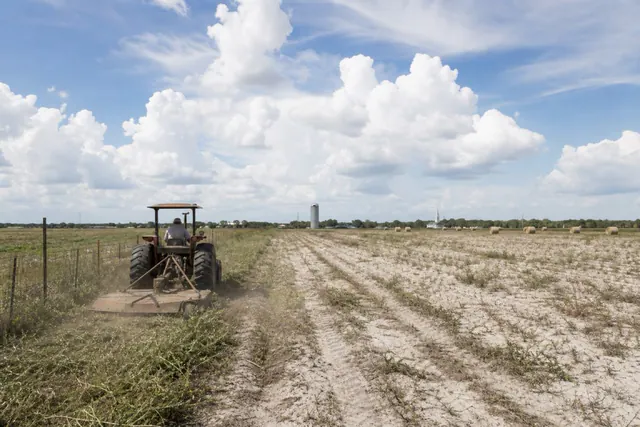
Hogtown Land Clearing puts LaCrosse property owners in front of a local land clearing contractor for mulching, clearing, and site prep around LaCrosse.
LaCrosse is Alachua County's smallest incorporated town — 316 people at the 2020 census, set in the open farm country of the county's north end where the horizon still belongs to field, silo, and sky. This is working land: vegetable ground, hay fields, cattle pasture, and the woodlots and fence rows that stitch them together.
Clearing here is farm infrastructure work. Fence rows grown into hedgerows get ground back so wire can be inspected and replaced. Fallow fields get knocked down before woody succession raises the cost of changing your mind. Field edges get pushed back to the survey line, ditches get their banks mowed, and the odd wet corner gets filled or accepted as the duck hole it wants to be.
North-county ground runs flatter and, in stretches, heavier than the sandhills south of it — some of the county's better farm soils sit up here, which means wet-week patience on the low fields and easy running on the sandy rises. An operator who works farm country prices by the actual field, not by a county-wide average.
Hogtown Land Clearing's promise in LaCrosse matches the town's scale: honest small-job economics, machines matched to farm work, and a written itemized quote a farm budget can actually use.
Fence rows as farm assets
A hedgerow-swallowed fence costs a farm twice — the wire fails unseen, and the woody row seeds volunteers into the field margin every year. The reset pass grinds the row back to a maintainable corridor, salvages or condemns the wire honestly, and puts the boundary back to work. Field-margin management guidance, including which hedgerow species carry value for wildlife and which are pure liability, runs through the county Extension office and UF/IFAS EDIS; the farm's own answer is usually a clean corridor with the occasional big live oak left for shade at the gate.
Once reset, the annual bush-hog pass down each row is an afternoon — the maintenance math every farm already understands.
Fallow fields and the succession clock
North Florida gives a fallow field about three years of grace: fennel and blackberry are mowing problems, but once sweetgum, cherry, and pine volunteers pass waist height, the field crosses from mowing rates into mulching rates, and a decade in it prices like land clearing. For ground that might return to production or go to a homesite sale, a cheap annual knockdown holds the clock at zero. Burning old field debris stays legal on ag land inside the state's authorization rules — details on the FDACS open-burning page — though grinding increasingly wins on labor alone.
The quote for a far-gone field maps it by zone, because most fields aren't uniformly gone — and mowing the mowable acres at mowing rates is how the bill stays sane.