 Hogtown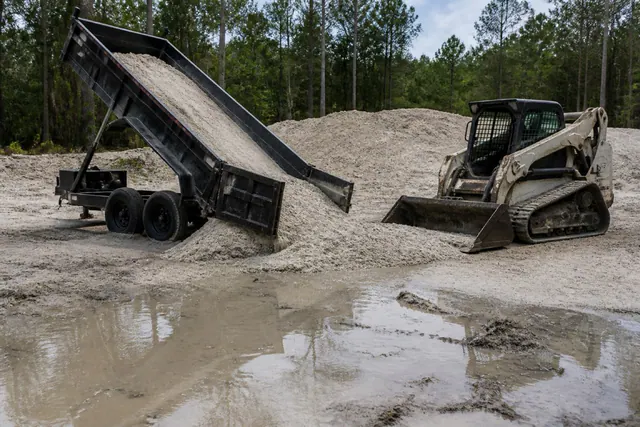
Hogtown Land Clearing puts Gainesville property owners in front of a local land clearing contractor for fill dirt services across Gainesville and Alachua County.
Half the dirt problems around Gainesville are really elevation problems: the backyard corner that ponds every June, the shed site a foot below its neighbors, the driveway edge that a wet summer keeps eating. Fill service is the whole chain — the right material, trucked in, spread, and compacted — not just a dumped pyramid and a wave goodbye.
Material selection is the part worth slowing down for. Clean sandy fill is the workhorse for raising grade around here — it moves, spreads, and compacts predictably. Limerock is the structural choice for drives and parking. Screened topsoil belongs only in the top few inches where something will grow. And 'free fill' from an unknown site is how people import construction trash, weed seed, and worse into their own yard.
How the material goes down decides what you actually bought. Proper placement is layered: a modest lift of sand, compaction, another lift, more compaction, repeated to height — a tall loose dump keeps settling for seasons, while stacked compacted layers hold their elevation. Around existing trees the discipline reverses: piling fill over a live oak's root zone smothers it slowly, so grade changes stop at the dripline or the tree was already part of the price.
Quantities are honest math: length times width times depth, divided into truckloads of roughly fifteen to eighteen cubic yards each. A quote in writing that shows loads, spreading hours, and compaction as separate lines lets you check that math against any competing bid in thirty seconds.
Tell Hogtown Land Clearing the spot, the target height, and what will sit on it, and a local contractor will measure it, spec the material, and price delivery through compaction on one free, itemized sheet.
Raising grade without drowning the neighbors
Water you push off your parcel arrives on someone else's, and Florida's drainage disputes are as old as its plats. The neighborly and legal standard is the same: raise your grade so the spot drains, but shape the edges so runoff exits where it exited before — or into ground that can absorb it, which our deep sands do exceptionally well. On larger fills, formal stormwater thinking applies, with the Suwannee River Water Management District as the permitting agency for most of the county, and Florida DEP setting the statewide frame.
One karst-country caution repeats from every other page on this site because it matters: a depression that swallows water may be doing geological work. Filling an active sink feature is not a landscaping decision — flag it, and get real advice first.
Reading a load of dirt before it drops
Good fill is boring: consistent color, no rebar or concrete chunks, no smell, no shiny streaks. Ask where it came from — a contractor with nothing to hide answers with the site name. County code enforcement, reachable through Alachua County, deals every year with parcels used as informal dumps under the label of free fill, and the cleanup lands on the landowner. Paying market rate for known-source material is the cheap option across any horizon longer than a month.
For growing ground, the layering rule is simple: structural sand below, real topsoil above, never blended. Soil-building guidance for our sandy profiles is a recurring subject in UF/IFAS EDIS publications.