 Hogtown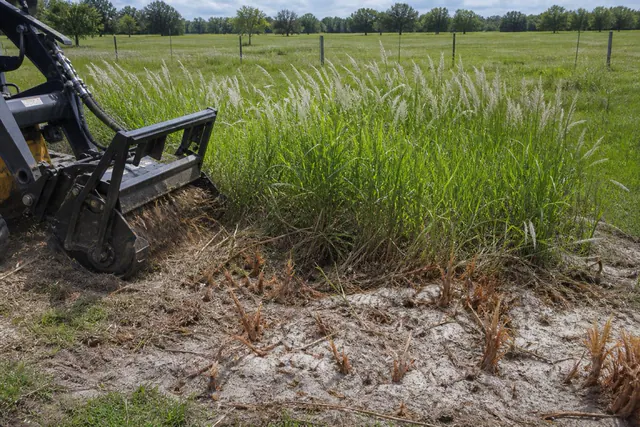
Hogtown Land Clearing puts Gainesville property owners in front of a local land clearing contractor for cogongrass & invasive removal across Gainesville and Alachua County.
The invasive that keeps north-central Florida land managers up at night is not a shrub — it is a grass. Cogongrass shows up as a dense, ankle-to-waist-high patch of yellow-green blades, often in an expanding circle, with fluffy white seed heads in spring. It crowds out wiregrass and forage, ruins pine regeneration, and burns hotter than native fuels when fire finds it. Alachua County's roadsides, pastures, and cutover timberland all carry infestations.
What makes cogongrass a different fight is the rhizome mat: a dense white network in the top foot of soil, sharp-tipped enough to punch through other plants' roots. Mow it and it shrugs; disc it carelessly and every chopped rhizome fragment becomes a new plant. Real control combines mechanical work with correctly timed herbicide treatment, repeated until the mat is exhausted — a program, not an appointment.
The machine's most important job on an infested site is not spreading the problem. Equipment that leaves a cogongrass patch carrying soil and rhizome fragments will plant the next infestation at the next job — which is why cleaning the machine before leaving an infested parcel is standard practice for contractors who take this seriously, and worth asking any bidder about.
Gainesville's woody invaders get the same clear-eyed treatment: camphor trees seeding out of old homesteads, chinaberry in fencerows, ligustrum and coral ardisia under hammock canopy, and climbing ferns sheeting over the east county's wetland edges. Each has a known playbook — cut-stump treatment for the sprouters, grinding for the ones that stay down — and a contractor working these species weekly knows which is which.
Hogtown Land Clearing connects you with an operator who treats invasives as the long game they are: walk the parcel free, map what is actually growing there, and quote the knockdown and the follow-up in plain, itemized writing.
Know the enemy: identifying cogongrass before it seeds
Cogongrass is easiest to confirm in April and May, when the silvery, cylindrical seed plumes stand above the blades. The rest of the year, look for the off-center midrib on the leaf, serrated edges that will nick a bare finger, and the expanding-circle growth habit. UF/IFAS maintains a dedicated cogongrass topic in EDIS with identification photos and the current treatment recommendations, and the Center for Aquatic and Invasive Plants at UF covers it alongside the state's other listed invaders.
Identification matters because the treatment window does: fall applications, when the plant is moving energy down into the rhizomes, do far more lasting damage than a cosmetic summer spray that burns the tops and leaves the mat intact.
Why fire and neglect both make it worse
Cogongrass and fire feed each other. The grass cures into a dense, resinous fuel that burns hotter and taller than the native groundcover it displaced — hot enough to kill mature pines that a normal understory burn would leave healthy — and the blackened ground it leaves behind regrows cogongrass first. State forestry authorities, whose landowner resources live at the Florida Forest Service, treat it as a priority pest for exactly this reason.
Doing nothing is also a decision. A patch the size of a truck today is a half-acre in a few seasons, and treatment cost scales with the mat. The economical moment is always now — knock it down mechanically, treat the regrowth on schedule, and hold the line at the parcel boundary.