 Hogtown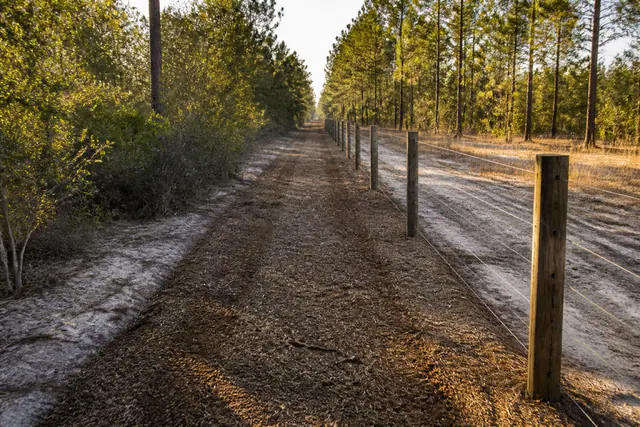
Hogtown Land Clearing puts Gainesville property owners in front of a local land clearing contractor for fence line clearing across Gainesville and Alachua County.
A fence line in north-central Florida is a running argument with biology. Cherry laurel and laurel oak seedlings sprout where birds perch on the wire, muscadine and catbrier lace through the mesh, and a handful of unattended seasons later the boundary has become a hedge concealing a wire problem. Clearing the line means grinding that growth back until the corridor is open, workable ground again.
The standard prescription is a mulched swath — commonly eight to twelve feet — along the fence, ground low enough that a truck or sprayer can drive it. On horse and cattle places toward Micanopy, Archer, and LaCrosse, that corridor is maintenance access; on residential acreage it is simply how the property line becomes visible again before a survey, a sale, or a new fence build.
Old fence rows hide iron, and iron is the enemy of mulcher teeth. Downed wire, T-posts swallowed by trunks, the odd truck part — a careful operator walks the line first, pulls what can be pulled, and slows the head where history is likely buried. That walk is also where the property-line conversation happens, because grinding brush on the wrong side of the line is a neighbor problem no one needs.
There is a fire-and-pest logic to clean lines too. A brushy fence row is a fuel wick running across the property and a highway for the exact species you don't want seeding into pasture — cherry laurel, chinaberry, and the vines. Keeping the corridor open breaks both paths, and once it is open, an annual mowing pass holds it for a fraction of the reset cost.
Give Hogtown Land Clearing the fence footage and a sense of how far gone it is, and a local contractor will walk the line and quote the reset — and if you want it, a keep-it-clear schedule — in writing, itemized, free.
Property lines, surveys, and not clearing the neighbor's trees
Fence lines and property lines are cousins, not twins — decades-old farm fences in this county wander off the deeded line more often than owners expect. Before grinding a wide swath, it is worth pulling the parcel map from Alachua County's GIS tools, and where a sale or dispute is anywhere on the horizon, having corners flagged by a surveyor. Cutting a neighbor's trees, even accidentally, carries real liability in Florida; a contractor who asks hard questions about the line before starting is protecting you.
Where the line is genuinely shared and both owners want it clean, splitting one mobilization down the middle is common sense — one machine, one day, two happy parcels.
Keeping wildlife habitat without keeping the jungle
Fence rows are wildlife corridors — that is precisely why birds plant them so efficiently. There is a middle path between jungle and moonscape: keep the occasional mature live oak or persimmon standing in the line for shade and wildlife, and grind the invasive and weedy fill around it. Guidance on managing rural land for wildlife alongside working uses is a staple of the Florida Fish and Wildlife Conservation Commission and the species pages in UF/IFAS EDIS.
The keep-list gets settled on the walk-through, tree by tree. Five minutes of flagging tape beats any amount of after-the-fact regret.