 Hogtown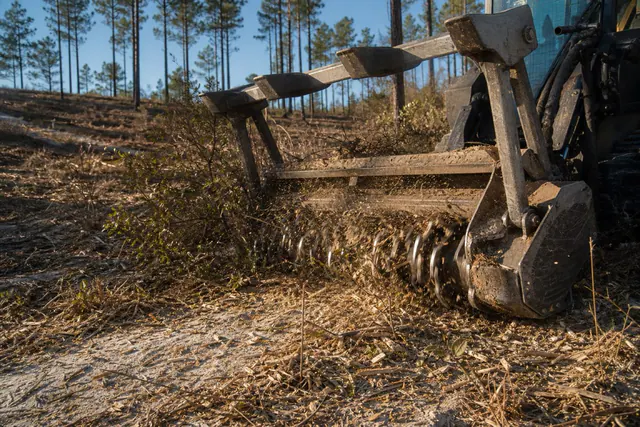
Hogtown Land Clearing puts Gainesville property owners in front of a local land clearing contractor for forestry mulching across Gainesville and Alachua County.
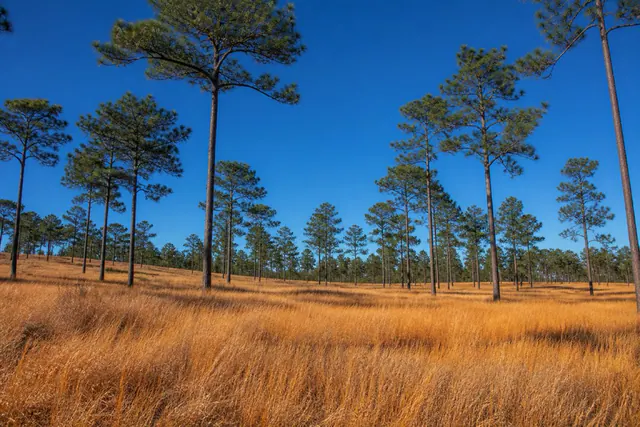
Around Gainesville, forestry mulching earns its keep on exactly the ground this county has the most of: sandhill acreage gone shaggy with turkey oak, laurel-oak volunteers, wax myrtle, and blackberry tangle under a canopy worth keeping. A tracked skid steer with a drum-style mulching head moves through that understory and shreds it in place, working around the longleaf pines and live oaks you want left standing. What was a wall of scrub at nine in the morning is a walkable parcel by supper, carpeted in chips instead of stacked in piles.
That carpet is the quiet advantage on Alachua County sand. The uplands west and north of Gainesville sit on deep, droughty sugar-sand that starts moving the moment it loses its cover — and the area's rain arrives hard, mostly as summer thunderstorms. Two to four inches of ground-up oak and myrtle takes the sting out of a downpour, shades the sand, and rots down into organic matter this soil badly needs.
Mulching also settles the fire question before it comes up. Piling and burning cleared debris in Florida means securing the Florida Forest Service's burn authorization first, cutting a break around the pile, and watching the weather and the drought index. Grinding the vegetation skips all of it: no smoke over the neighbors, no waiting on an authorization window, no pile smoldering into the night.
One machine doing the whole job is also what keeps quotes reasonable. There is no excavator loading a dump truck, no tipping fees at the transfer station off Waldo Road, and usually no re-grading, because tracks spread the machine's weight and the root mat stays in the ground holding the sand together.
Tell Hogtown Land Clearing the acreage, what is growing on it, and what you want it to look like after, and a local contractor who runs a mulcher on these soils every week will walk it and hand you a written price, split out line by line.
Built for sugar-sand ground and 50-inch summers
The Gainesville area takes close to fifty inches of rain in a typical year, and NWS Jacksonville records show the bulk of it landing between June and September as short, violent afternoon storms. Bare sand has no defense against that pattern — it sheets, gullies, and ends up in the nearest swale. A mulched surface absorbs the raindrop impact instead, which is why parcels ground in place look almost unchanged after a storm that would carve channels across a scraped one.
The chips keep working long after the machine trailers out. University of Florida IFAS publications on soil and forage management make the same point repeatedly: sandy Florida soils are chronically short on organic matter, and a decomposing mulch layer feeds it back while holding moisture through the dry, windy weeks of April and May. By the second spring, the bottom of the layer is already turning dark and crumbly.
Why grinding beats burning in Alachua County
Open burning of land-clearing debris is legal in Florida only inside the state's rules — setbacks, hours, and an authorization from the Florida Forest Service for pile burns, all laid out on the state's open burning page. In a dry spring, authorizations tighten just when everyone wants to clear, and a pile of green oak can smolder for days. Mulching removes the fire from the plan entirely.
There is a neighborly angle too. Much of the clearing demand here sits inside Gainesville's growth ring — Jonesville, the Newberry Road corridor, the acreage neighborhoods off Millhopper Road — where the next house is close enough that smoke is a problem even when it is legal. A mulcher makes noise for a day; a burn pile makes enemies for a week.