 Hogtown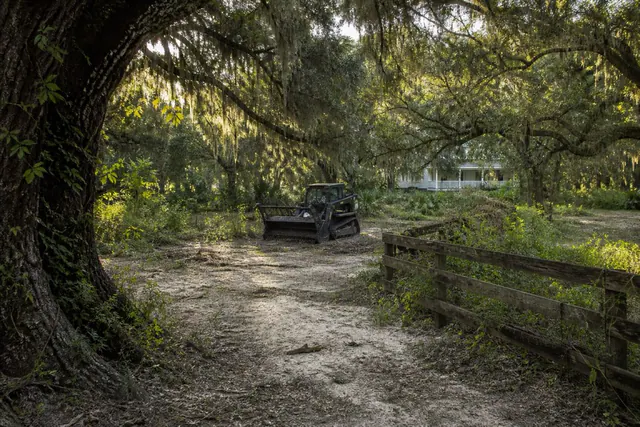
Hogtown Land Clearing puts Micanopy property owners in front of a local land clearing contractor for mulching, clearing, and site prep around Micanopy.
Micanopy — 648 residents in 2020, and by its own history the oldest continuously inhabited inland town in Florida — wears its live-oak canopy like a title. The historic district made the National Register in 1983, the antique shops fill the old storefronts, and the land around town runs to small horse farms, hammock edges, and acreage that borders Paynes Prairie's northern rim.
Clearing here is curation, not conquest. The oaks are the town's identity, so the work is what grows beneath and between them: pasture corners surrendering to wax myrtle and cherry, board and wire fence lines swallowed by vine, hammock edges creeping into fields, and storm damage from limbs that a two-hundred-year-old oak sheds without apology.
The horse farms set the tone for how jobs run — animals rotated away from the work, gates coordinated, no fresh-cut cherry left within reach of a paddock, and finishes chosen for hooves: ground smooth, debris genuinely gone, mulch where it helps and hauled where it doesn't.
Around the prairie rim, the etiquette is environmental: the wet prairie and its drainages are protected landscape, so upland clearing keeps its silt and its debris to itself. It is the same mulch-first, buffer-respecting method used everywhere on this site, applied where the neighbor is a state preserve.
For a Micanopy owner, Hogtown Land Clearing's promise is a contractor who can tell a keeper oak from a problem oak at a walk — and puts the difference in a free, itemized, written quote.
Working under heritage canopy
Micanopy's mature live oaks are functionally irreplaceable on any human timescale, and machine work near them follows arborist logic: no grade changes or fill inside driplines, no trenching through major roots, vines cut at the base and left to wither rather than ripped from the crown, and compaction kept off the root zone. Species longevity and root-zone guidance are covered across UF/IFAS EDIS publications, and for genuinely historic specimens a consulting arborist's hour is cheap against the tree.
The understory is a different conversation — laurel cherry, ardisia, and ligustrum colonize these shaded hammock edges aggressively, and clearing them out is good for the oaks, not just the view.
The prairie next door
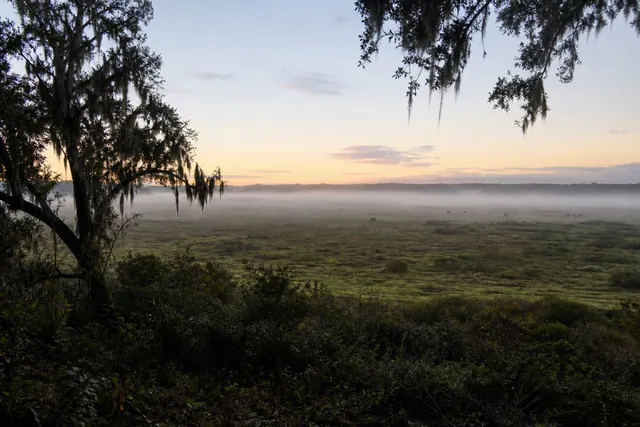
Paynes Prairie Preserve State Park — the wet prairie basin where bison and cracker horses roam — frames Micanopy's south side, and many parcels drain toward it. Practical stewardship for clearing jobs on that rim: vegetated buffers stay along wetland edges, stormwater leaves a site slow and clean, and invasive material never gets pushed toward the boundary. The state park frame sits under Florida DEP, and the prairie's natural history — worth knowing if you live beside it — is richly covered by the Florida Museum of Natural History in Gainesville.
None of it complicates ordinary upland work; it just defines the professional standard on this particular edge of the county.