 Hogtown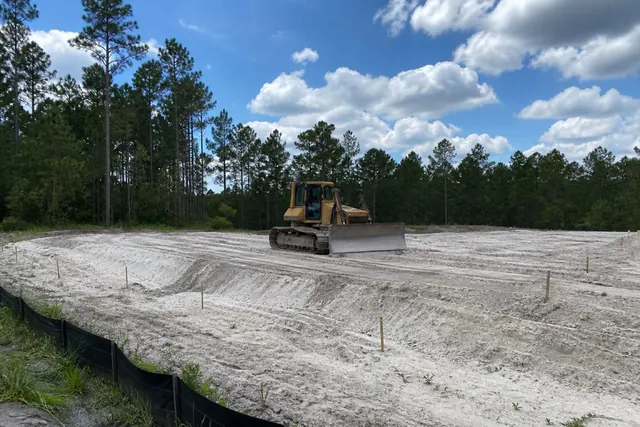
Hogtown Land Clearing puts Gainesville property owners in front of a local land clearing contractor for grading & site prep across Gainesville and Alachua County.
Clearing gets the vegetation off; grading decides how the land behaves for the next fifty years. On the rolling sand ridges around Gainesville, that means shaping a pad that sheds the summer downpours away from the slab, keeping the driveway from washboarding down a grade, and respecting the fact that in this county, water you can't see is doing most of the work underground.
The typical residential package here is straightforward: strip and stockpile the organic layer, cut and fill to the pad elevation, compact in lifts, and leave crowned, drained surfaces everywhere a vehicle or a foundation will live. A compact dozer and a skid steer handle most homesites; laser or GPS grade control comes out when a slab spec demands tighter tolerance than an experienced eye delivers.
Sugar sand is a double-edged material to grade. It cuts easily, drains superbly, and compacts predictably at the right moisture — but it also refuses to hold a steep slope and ravels at edges. Local practice leans on gentle grades, generous swales, and getting groundcover or mulch onto finished surfaces fast, because a bare sand slope and one thunderstorm will redesign your grading for you.
Erosion and stormwater rules scale with the project. A homesite pad usually needs nothing more than silt fence discipline and common sense; bigger disturbances can cross into environmental resource permitting through the water management district. Knowing where those thresholds sit — and pricing the silt fence, not improvising it — is part of a professional quote.
Tell Hogtown Land Clearing what is going on the site — house, barn, drive, or all three — and a local contractor will walk the parcel, shoot the grades, and hand you an itemized written price for exactly the dirt work the plan needs.
Grading for a county that drains straight down
Western Alachua County is internally drained karst: much of the rainfall never reaches a river by surface flow, it soaks through the sand into the limestone below. That is why the region's aquifer is both productive and touchy, and why the Suwannee River Water Management District oversees larger land-alteration projects. For a homesite, the practical rules are modest: don't grade fill into sinkhole depressions, keep septic and pad elevations honest, and let swales deliver roof water to ground that can drink it.
The east side of the county plays by different physics — flatwoods soils with a shallow hardpan perch water near the surface in wet season. Pads out toward Hawthorne and Melrose are built up rather than cut in, and ditching patterns that have worked there for a century are worth reading before changing.
What 'pad-ready' should mean on your quote
Pad-ready is a term worth pinning down in writing. A defensible version includes: cleared and grubbed footprint, fill placed and compacted in lifts to the builder's spec, finished pad within tolerance of the target elevation, positive drainage away on all sides, and stabilized disturbed areas. If an engineer requires density testing, coordinate it before the machine leaves — mobilizing twice is the expensive way to pass a proctor.
Jurisdiction sets the paperwork around the pad. For unincorporated parcels, Alachua County is the authority on development approvals, and summer storm timing straight from NWS Jacksonville forecasts drives the schedule: experienced crews pour effort into getting bare dirt covered before the afternoon radar lights up.