 Hogtown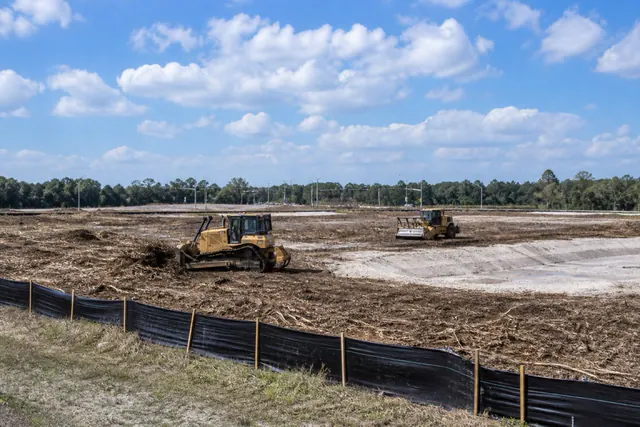

Hogtown Land Clearing puts Gainesville property owners in front of a local land clearing contractor for commercial site clearing across Gainesville and Alachua County.
Commercial clearing in the Gainesville market is a production job with an audience: acreage coming down along the retail corridors west of I-75, subdivision phases turning over former pasture in Newberry and Alachua, and institutional projects orbiting the university's economy. The machinery is bigger, the schedule is contractual, and the erosion-control inspector knows the site's name.
Scope runs from first stake to pad-ready: clearing and grubbing to the limits shown on the civil plans, protection fencing around every tree the plan saves, windrowing and processing vegetation — mulched, hauled, or ground for reuse as site stabilization — then rough grading toward the pond and pad elevations the engineer drew. Coordination with the earthwork and utility contractors that follow is half the value of doing it right.
The regulatory frame is real and priced in, not discovered: land development approvals from the local jurisdiction, tree mitigation math where protected specimens come down, an NPDES construction permit with its stormwater pollution prevention plan once disturbance crosses an acre, and environmental resource permitting through the water management district. Sites that treat the silt fence as decoration meet the enforcement side of those agencies quickly.
This county adds its own line items: gopher tortoise surveys on sandy parcels before machines mobilize, karst features that stormwater designs must respect rather than fill, and — on former pasture — cogongrass zones handled with equipment hygiene so the project doesn't seed its own landscaping contract with the state's worst grass.
Send Hogtown Land Clearing the civil set or even the concept plan, and a local contractor will walk the parcel against the drawings and return a bid-grade, line-item quote — clearing, grubbing, processing, haul, and rough grade priced separately so value engineering has something to work with.
Stormwater is the schedule's real boss
On any commercial site disturbing an acre or more, the NPDES construction generic permit and its SWPPP govern the sequence: perimeter controls and inlet protection go in before mass clearing, disturbed areas get stabilized on the clock, and inspections happen after every qualifying rain — which, in a Gainesville summer, means often. The state program sits under Florida DEP, with environmental resource permitting for most of the county running through the Suwannee River Water Management District. A clearing contractor who maintains the controls as part of daily production keeps the site off the violation ledger and the schedule off the rocks.
Karst adds the local nuance: retention designs here often lean on the sand's infiltration capacity, which makes protecting that capacity — no compaction or fines washed into the pond bottom during construction — a clearing-phase responsibility.
Trees, tortoises, and the pre-clearing checklist
Two surveys precede the first machine on a well-run Alachua County site. The tree survey reconciles the protected and heritage specimens on the plans with the trunks on the ground — local codes attach real mitigation costs to regulated trees, and county development office is the authority for unincorporated parcels. The wildlife survey looks for gopher tortoise burrows, which on these sands is not a formality; relocation under FWC permitting takes lead time that must live in the schedule, not in the surprise column.
Both surveys convert risk into line items. The projects that stall are the ones that skipped the walk.