 Hogtown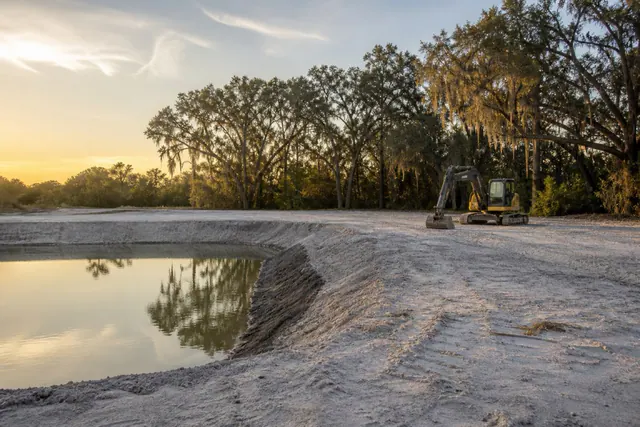
Hogtown Land Clearing puts Gainesville property owners in front of a local land clearing contractor for site development support across Gainesville and Alachua County.
Between a cleared parcel and a foundation crew there is a stretch of unglamorous, essential work: stormwater ponds dug to design, building pads built to spec and tested, internal roads roughed in, erosion controls maintained through every inspection. Site development support is that stretch, delivered as machine work coordinated with the project's engineer rather than improvised around them.
In the Gainesville market this work has a distinct local flavor. Ponds here are usually dry retention dug into sand that drinks water — their value is the infiltration rate, so excavation technique protects the pond bottom from compaction and silt. Pads rise from cut-and-fill balanced across the site because imported fill is money on wheels. And every plan navigates the same trio: karst below, tortoises on the sand, summer storms on the radar.
The support model matters as much as the iron. Developers and GCs in this market rarely need another prime contractor; they need a dirt-side partner who reads the civil set, prices honest unit rates, keeps the SWPPP binder current, and communicates in submittal-and-RFI language. That is the shape of the service this page describes.
Typical packages: pond and swale excavation with liner-grade tolerance where specified; pad construction with density testing coordinated; roadbed shaping and limerock base placement; rip-rap and outfall work; long-cycle erosion-control maintenance between phases; and the punch-list dirt work that surfaces the week before a certificate of occupancy.
Hogtown Land Clearing connects the project with a local contractor who does this daily. Send the plan set and the phasing, and the response is a scoped, itemized proposal a construction manager can drop straight into a bid tab.
Retention ponds in sand: dig for infiltration
Most Gainesville-area stormwater designs bank on the same asset: sand that percolates. A dry retention pond here passes or fails on the condition of its bottom — over-compact it with equipment traffic or let construction fines wash in, and the design infiltration rate goes with it, along with the engineer's signature. Good excavation practice digs the final foot late, from the outside where possible, and keeps upstream disturbance stabilized. The permitting frame for these systems runs through the Suwannee River Water Management District under state rules coordinated by Florida DEP.
Karst inspects the pond too: a solution feature opening in a pond bottom is a known north Florida plot twist, documented in USGS karst literature. Experienced operators watch the excavation for the signs and get the engineer involved early rather than after the pond drains somewhere surprising.
Keeping a site inspection-ready between phases
Development schedules breathe — financing, weather, and supply chains all pause projects — but the stormwater obligations never pause with them. Perimeter controls still need maintenance, stabilization still has deadlines, and inspections continue while the site waits. A standing maintenance scope — silt fence repair, re-mulching bare areas, pond and swale cleanout after storms — costs little and keeps a paused project from accumulating violations with county or state inspectors while it sleeps.
The same standing arrangement smooths restart: the contractor who kept the site clean through the pause already knows its drainage quirks when the schedule wakes up.